
What is a Disparity Study?
Billions of dollars in government spending each year funnel to the bank accounts of America’s small and large businesses. Business owners everywhere rejoice when they receive the announcement they have been awarded a new federal, state, city or county award for their goods or services. “Now hiring” ads go up, investments are planned for new machinery and smiles abound.
All is well. Except it’s not.
Thousands of other firms, many of them small businesses or minority owned firms (MBEs) aren’t celebrating. In fact, according to the Department of Labor (DOL), on average, only 3% of all 2021 federal contracts went to MBEs and that’s against the backdrop of the 24% eligible minority businesses registered for federal contracts.1
A disparity study is a procurement program evaluation conducted by a professional firm which collects data and analyses contract practices, including specific details of participation by minority firms and their award in comparison to other non-minority or women-owned enterprises (MWBEs).
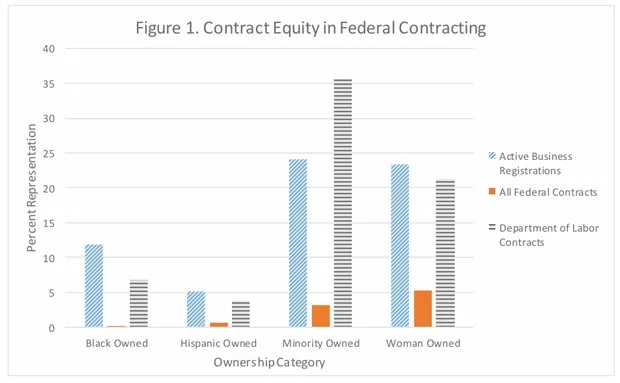
Graphic: U.S. Department of Labor, “Progress in Procurement: Equity in Federal Contracting,” 2021. Retrieved from https://www.dol.gov/sites/dolgov/files/OPA/blog/equity-in-federal-contracting.pdf.
Why Disparity Studies are Important
Disparity studies are an important component of public policy and in proper spending of tax dollars for states, counties, cities, and all public agencies. It ensures procurement participation is fairly distributed among all businesses in a community and determines if involvement is equally based according to pre-established equity designations.
Disparity studies are an important gauge to examine impartiality in the procurement process. It identifies any gaps in opportunities, especially for historically underrepresented firms such as minority- and women-owned businesses (MWBEs).
Typically, the following race/ethnicity/gender classifications will be utilized:
· African American
· Asian American
· Hispanic American
· Native American
· Caucasian Women
· Non-M/WBEs
What is the Disparity Study Process?
A disparity study may include the following steps:
1. Kick-off meeting.
At the onset of the process, it is important for the procurement team and other staff to meet with the firm conducting the study. Goals and methodology can be agreed upon and sources of data to be collected can be identified.
2. Determination of Relevant Category of Procurement Areas (Industry Categories):
· Heavy Construction (Civil)
· Building Construction
· Professional Services
· Commodities
· Special Trade Construction
· Other Services
3. Data collection and cleaning.
4. Legal Analysis and policy review.
5. Availability analysis.
6. Relevant market analysis.
7. Utilization analysis.
8. Statistical disparity analysis.
9. Anecdotal evidence.
· Includes surveys, interviews, and focus groups with business owners and stakeholders.
10. Final report and presentation of findings.
Do You Need a Disparity Study?
Key questions which might prompt the need for a disparity study include:
· Are all businesses, including MWBEs represented in procurement contracts?
· Is there significant underspending or underutilization of MWBEs?
· All other factors equal, such as goods being offered and quality of services, does a disparity exist between minority and non-minority businesses who win contract bids?
Answers to these questions make disparity studies a valuable tool for procurement and purchasing departments, and for governments wanting to maintain inclusivity in their public spending.
Your state, county, city, or organization may need a disparity study if:
· It has been several years since your last complete disparity study.
· You are looking to evaluate or re-evaluate your contracting program following recent legislation changes.
· You are a public agency wanting to implement supplier diversity programs into your procurement process.
· You are part of schools, transportation agencies or utility authorities who award construction or other goods and services contracts and want to secure an equitable distribution of awards or to create small business set-aside designations.
· You are looking for a legally defensible inclusion program.
An expert disparity study provides tremendous value to municipalities as they work for inclusion and fairness in their business community and strive to remain accountable to their taxpayers. At the end of the day, disparity studies provide a baseline and with proper execution of new goals from a complimentary implementation plan, it can direct a path forward for equity and ensure non-discrimination, where all types and sizes of businesses receive an equal chance to thrive, and win.
Why Choose Griffin & Strong for Your Next Disparity Study
Griffin & Strong, P.C. (G&S) is a respected law and public policy consulting firm based in Atlanta, GA and is the leading firm in disparity study research and analysis. Since 1992, the firm has conducted over seventy (70) major studies and plans as a prime contractor, representing individual clients, small businesses, corporations, and government entities in public policy consulting, legislation, contract compliance, supplier diversity consulting, and disparity studies. G&S head Rodney Strong was recently honored as a Blue Legend Award recipient for his legacy of work in supplier diversity. Our full-time staff include attorneys for legal analysis and public policy guidance. As always, it is our goal to ensure we produce legally defensible disparity studies.
Reference:
1 Source: U.S. Department of Labor. “Progress in Procurement: Equity in Federal Contracting.” Published 2021. Available at https://www.dol.gov/sites/dolgov/files/OPA/blog/equity-in-federal-contracting.pdf.