Underscoring the Pressing Need to Avoid Discrimination
Mid-America Milling Case Updates
A significant preliminary ruling was issued in 2024 by a federal district court in the Sixth Circuit in a case involving the presumption of disadvantage applied by the U.S. Department of Transportation in administering its Disadvantaged Business Enterprise (DBE) Program. That case was recently dismissed, however, precluding any final ruling on the merits – meaning that the ultimate legality of the presumption will not be decided by the court.
In Mid-America Milling Co., LLC v. USDOT,[1] the court issued a preliminary injunction in favor of two non-minority owned companies that regularly bid on federal highway projects who claimed that presuming disadvantage based on race/ethnicity or gender violates the constitutional rights of non-minorities.
Applying the strict scrutiny standard (under Croson), the district court preliminarily ruled that USDOT did not adequately meet either prong of the standard. With respect to the “compelling state interest” requirement, the court reasoned that the nationwide statistical proof and anecdotal evidence offered was too “general” to meet the standard. In so doing, however, the court expressly recognized that the Sixth Circuit views the factual predicate requirement in a manner different from, or inconsistent with, other federal circuit courts in addressing federal programs.
The court also reasoned that the presumption of disadvantage was not narrowly tailored to remedy any disparities shown in the statistical proffer, because the government did not satisfactorily show that race-neutral efforts at remediation had been meaningfully tried, and also because the program had no logical “end date” when the presumption would no longer be applied/necessary.[2] Based on these findings, the court issued a preliminary injunction in favor of the plaintiffs in states in which they typically bid for federal highway projects.[3]
The case was thereafter set for a trial on the merits, wherein plaintiffs would seek a permanent injunction against the practice/program.
There will not be a final ruling on the merits of plaintiffs’ constitutional claim, however, because the court recently dismissed the case in its entirety as moot. Specifically, the court ruled that the Interim Final Rule (IFR) promulgated by USDOT in October 2025 effectively provided plaintiffs with all of the relief that they sought in the lawsuit – as the IFR eliminated the presumption of disadvantage that plaintiffs claimed was unconstitutional and should not be applied to DOT contracts.[4] Accordingly, the court dissolved the preliminary injunction previously issued, denied all pending matters in the case as moot, and dismissed/closed the case.[5]
Thus, the possibility that other courts might adopt the reasoning supporting the prior preliminary injunction in Mid-America Milling remains, but no final ruling on the ultimate merits will be reached in the case, limiting its significance as precedent.
[1] 2024 WL 4267183 (E.D. Ky., September 23, 2024).
[2] Id. *9-*10.
[3] Id. *12-*13.
[4] See Mid-America Milling Co. v. USDOT, Case No. 3:23-cv-00072 (E.D.Ky) March 19, 2026 “Opinion & Order” pp. 15-17.
[5] Id. at 17.
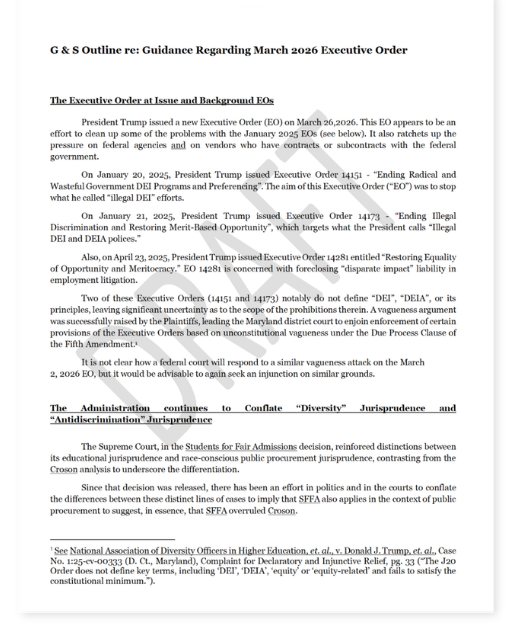
The Executive Order at Issue and Background EOs
President Trump issued a new Executive Order (EO) on March 26,2026. This EO appears to be an effort to clean up some of the problems with the January 2025 EOs (see below). It also ratchets up the pressure on federal agencies and on vendors who have contracts or subcontracts with the federal government.
On January 20, 2025, President Trump issued Executive Order 14151 - “Ending Radical and Wasteful Government DEI Programs and Preferencing”. The aim of this Executive Order (“EO”) was to stop what he called “illegal DEI” efforts.
On January 21, 2025, President Trump issued Executive Order 14173 - “Ending Illegal Discrimination and Restoring Merit-Based Opportunity”, which targets what the President calls “Illegal DEI and DEIA polices.”
Also, on April 23, 2025, President Trump issued Executive Order 14281 entitled “Restoring Equality of Opportunity and Meritocracy.” EO 14281 is concerned with foreclosing “disparate impact” liability in employment litigation.
Two of these Executive Orders (14151 and 14173) notably do not define “DEI”, “DEIA”, or its principles, leaving significant uncertainty as to the scope of the prohibitions therein. A vagueness argument was successfully raised by the Plaintiffs, leading the Maryland district court to enjoin enforcement of certain provisions of the Executive Orders based on unconstitutional vagueness under the Due Process Clause of the Fifth Amendment.[6] It is not clear how a federal court will respond to a similar vagueness attack on the March 2, 2026 EO, but it would be advisable to again seek an injunction on similar grounds.
[6] See National Association of Diversity Officers in Higher Education, et. al., v. Donald J. Trump, et. al., Case No. 1:25-cv-00333 (D. Ct., Maryland), Complaint for Declaratory and Injunctive Relief, pg. 33 (“The J20 Order does not define key terms, including ‘DEI’, ‘DEIA’, ‘equity’ or ‘equity-related’ and fails to satisfy the constitutional minimum.”).
The Administration Continues to Betray Its Apparent Goals by Conceding that Discrimination is Still Prohibited and Actionable
After release of the January 2025 “anti-DEI” EOs, the Attorney General of the United States essentially recognized that some “discrimination” can still be applied if it is consistent with the controlling legal standards:
Prohibition on Protected Characteristics as Criteria: Using race, sex, or other protected characteristics for employment, program participation, resource allocation, or other similar activities, opportunities, or benefits, is unlawful, except in rare cases where such discrimination satisfies the relevant level of judicial scrutiny.[7]
Similar recognition appears in the text of the March 26, 2026 EO itself. In Section 1, the Administration notes that “DEI activities are not only unethical and often illegal, but also cause inefficiencies, waste, and abuse within entities that engage in such practices.” (emphasis added).
The plain language of the EO indicates that DEI activities are not always illegal – leaving open the question of which DEI activities remain legal. We would argue that race-based remedial actions supported by a robust disparity study are within this exception, for the reasons set forth in the “conflation” discussion above.[8]
[7] July 29, 2025 Memorandum for All Federal Agencies, “Guidance for Recipients of Federal Funding Regarding Unlawful Discrimination,” Section II. The exception(s) presumably would include race-conscious procurement policies that can meet the strict scrutiny standard consistent with Croson.
[8] The March 26, 2026 EO also notes that it continues to be “the policy of the United States to promote economy and efficiency in Federal contracting by preventing racial discrimination.” Meaning that anti-discrimination measures are still appropriate.
Executive Orders May Be Unenforceable Due to Constitutional Overreach Regarding Separation of Powers
The “disparate impact” theory of liability has been a part of anti-discrimination jurisprudence for over fifty years,[9] and was codified by Congress as part of the Civil Rights Act of 1991 given concerns that the judiciary might ultimately limit or prohibit it.
By attempting to undo what Congress has previously done using its exclusive power to legislate, President Trump appears to be violating important separation of powers standards.
The Constitution “exclusively grants the power of the purse to Congress, not the President.” City & County. of San Francisco v. Trump.[10] This power is “directly linked to [Congress’s] power to legislate,” and “[t]here is no provision in the Constitution that authorizes the President to enact, to amend, or to repeal statutes.” Id., quoting Clinton v. City of New York[11] (“In both legal and practical effect, the President has amended two Acts of Congress by repealing a portion of each. ‘[R]epeal of statutes, no less than enactment, must conform with Art. I.’ There is no provision in the Constitution that authorizes the President to enact, to amend, or to repeal statutes.”) (citation omitted).[12]
Any EO that appears to be an effort to overrule or effectively repeal the Civil Rights Act of 1991, at least as it relates to the “disparate impact” theory in discrimination cases, would appear to violate the separation of powers, wherein Congress is exclusively tasked with legislating. See Clinton v. City of New York, supra (“There is no provision in the Constitution that authorizes the President to enact, to amend, or to repeal statutes.”).
[9] See Griggs v. Duke Power Co., 401 U.S. 424 (1971).
[10] 897 F.3d 1225, 1231 (9th Cir. 2018).
[11] 524 U.S. 417, 438 (1998).
[12] See also Cunningham v. Neagle, 135 U.S. 1, 83–84 (1890) (It is not the prerogative of the President “to make laws or a law of the United States,” which would plainly “invade the domain of power expressly committed by the constitution exclusively to Congress.”). In fact, it is the duty of the President, and, by extension, the executive branch agencies he administers, to “take care that the laws are faithfully executed.” U.S. Const. art. II, sec. 3.
The Administration is Making the G&S Marketplace Efficiency Argument for Us
Finally, though coming from a very different initial premise than G&S (i.e., “reverse discrimination” concerns) it is notable that the Administration has, in all material respects, adopted a core argument often made by G&S: that an inefficient marketplace, caused by discrimination (past or present, public or private), underscores the pressing need to avoid and/or remedy all forms of discrimination in government procurement.
DEI activities also create unnecessary costs by reducing the pool of available labor by artificially limiting companies to hiring or promoting certain individuals, suppliers, or intermediaries based on their race or ethnicity. These costs are inevitably passed on to the Federal Government when it contracts with companies who engage in racially discriminatory DEI activities, or who use subcontractors who do so. [Section 1]
G&S would argue that limiting opportunities for MWBE/DBE firms raises the same economic concerns for procuring governments (including the federal government), emphasizing the need for anti-discrimination efforts like those permitted by Croson.