
What is the Interim Final Rule (IFR)?
As a certified disadvantaged business, you take pride in meeting the eligibility requirements for a government Request for Proposal (RFP). Afterall, it was a lot of work to get certified. You had to fill out forms and be interviewed by government agencies. You submitted multiple documents, checked all of the boxes, and even made your business location ready for inspections. Now, through no fault of your own, with the U.S. Department of Transportation’s (USDOT) Interim Federal Rule (the “IFR”) you stand to lose it all.
Don’t panic! You are not alone.
Thousands of other certified firms across the country are grappling with the same sudden shock to the system. How does the IFR affect Disadvantaged Business Enterprise (DBE) eligibility? Whether you are a DBE, or a ACDBE you are directly affected by the USDOT’s new IFR and must take action to recertify your business if you desire to compete on federal contracts as a disadvantaged or minority firm.
What the DBE Rule Change Really Means For Your Certified Business
Disparity studies are an important component of public policy and in proper spending of tax dollars for states, counties, cities, and all public agencies. It ensures procurement participation is fairly distributed among all businesses in a community and determines if involvement is equally based according to pre-established equity designations.
Here are the IFR facts:
USDOT has decided not to continue the presumption of disadvantage as part of the certification process, which also affects the goals program in the short-term.1
The IFR removes race- and sex- based presumptions from the DBE Program.
Currently, no firm that was previously certified using the presumption is a certified DBE; they must seek “new” certification using the non-presumption method (including a Personal Narrative (PN), describing the nature of the disadvantage and any supporting documents).
Because these firms are no longer certified, no DBE/ACDBE goals are being attached to any new solicitations/contracts at this time. However, goals can be set in the future.
The timing for “new” certification with the Georgia Department of Transportation (GDOT), and thus the timing for the goals program to be re-started, is unclear at present.
DBE certifying agencies have an open-ended deadline for conducting their re-evaluation and recertification of previously certified DBEs.
USDOT has mandated that DBE goals be removed from ALL contracts, including those executed before the effective date.
Goals on contracts already in the performance phase must be removed via addendum. However, subcontractors cannot be terminated except for cause.
Exception: On-call contracts with goals that were executed before October 3, 2025 could continue with goals, and subcontractors cannot be terminated except for cause.
Re-certification should be initiated with your original certifying agency.
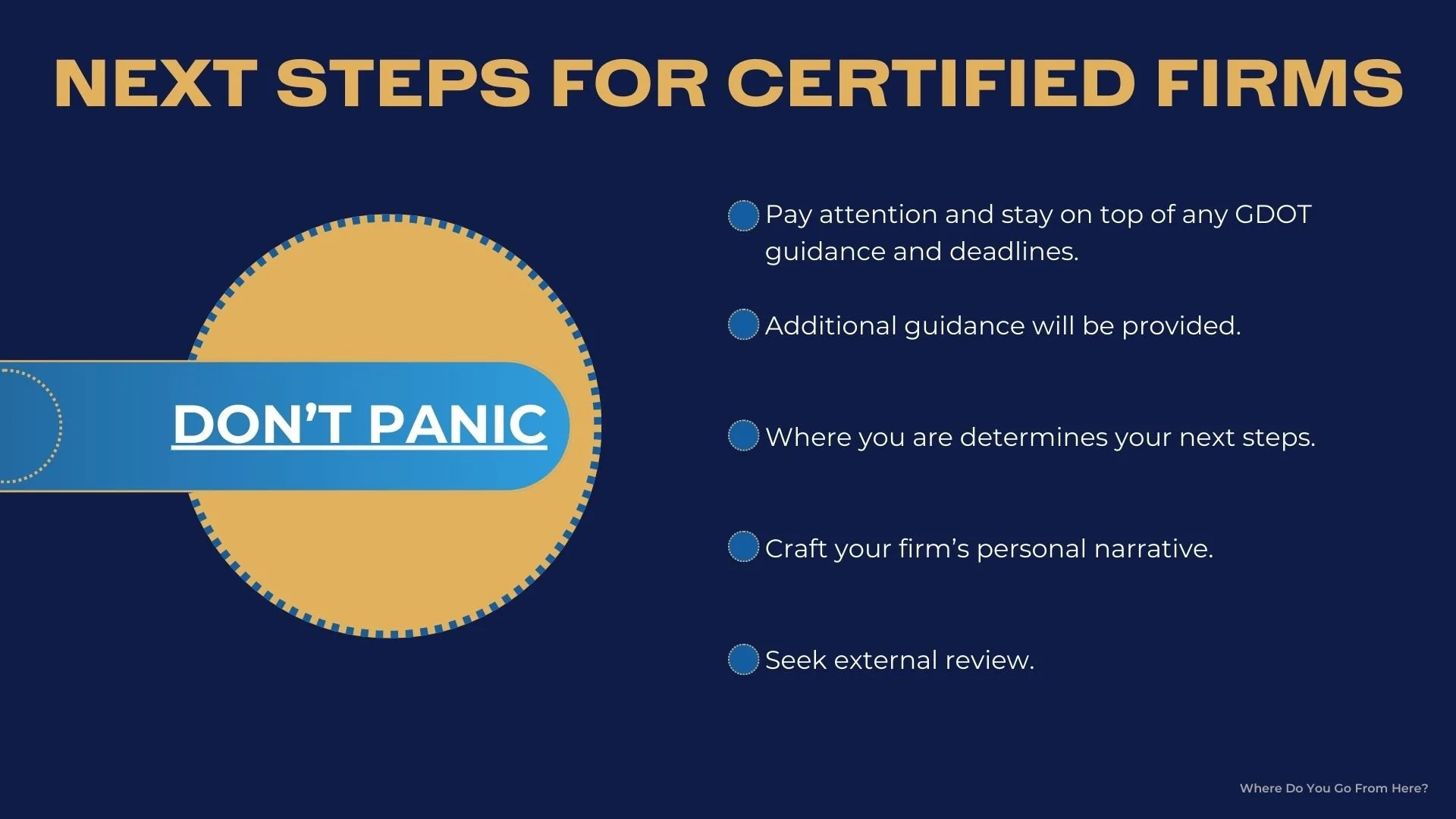
Next Steps to Comply with the IFR
When does the IFR go into effect? It’s unclear at this time, but there are clear requirements your disadvantaged or minority enterprise must meet to be certified once again. Take action now to prepare. Most importantly, don’t be overwhelmed. Stay informed. The USDOT FAQs can be found here.2
Important steps a DBE or MWBE firm can take since the October 2025 IFR changes:
1. Pay attention and stay on top of any guidance and deadlines from your local certifying agency. Conduct research where necessary.
2. Reach out to your certification entity. Most certifying organizations have already asked the USDOT tough questions regarding how best to comply with the IFR . Many agencies have published guidance specific to their region or state. In general, these organizations are eager to help and to get you re-certified.
3. Where you are determines your next steps. Each state is different. Look to your local level for accurate information and action items.
4. Revisit your personal narrative and outline the core barriers you’ve faced.
5. Craft your firm’s personal narrative.
6. Seek external review
a. Compliance audit of your personal narrative
b. Legal or technical assistance
c. Research support where needed
How to Write Your IFR USDOT Certification Narrative
Current certified firms must resubmit their Personal Net Worth (PNW) (threshold: $2,047,000) statements along with their PN to establish disadvantage. Disadvantage may be established by a preponderance of the evidence (it must be more likely than not that you can establish disadvantage) through one or more of any of the following categories:
· Education
· Employment
· Business History
Notably, PNs cannot rely in whole or in part on race or gender/sex.
“Your story is still your story.”
Take these important steps to write your DBE or ACDBE personal narrative:
Step 1: Revisit Your Original Personal Narrative & Outline the Core Barriers You Faced
Step 2: Re-frame
· Remove references to race and gender
· Keep your story
Step 3: Add Comparison & Evidence
· What did others have that you did not?
· Identify areas to add comparative data or evidence; get into the “why”
· Again, make sure that your comparative groups are not referred to by race or gender
Step 4: Seek External Review
· Compliance audit of your personal narrative
· Legal or technical assistance
· Research support where needed
Do you still need help writing your certification narrative? Griffin & Strong can assist you now.
This is not the end of DBE or supplier diversity. It is a transition from presumption to proof, from identity to evidence, and from assumption to analysis. Don’t drop your certification. Stay informed. Stay engaged.
Griffin & Strong, P.C. (G&S) is a respected law and public policy consulting firm based in Atlanta, GA and is the leading firm in disparity study research and analysis. Since 1992, the firm has conducted over seventy (70) major studies for cities, states and other government entities. G&S CEO, Rodney Strong was recently honored as a Blue Legend Award recipient for his legacy of work in supplier diversity and continues to educate businesses and organizations about the new IFR. Our full-time staff includes attorneys for legal analysis and public policy guidance. As always, it is our goal to ensure we produce legally defensible work. Reach out now to make an appointment. Call today! 404-584-9777.
Reference:
DBE IFR Guidance.10-03-2025.pdf
1 Source: U.S. Department of Transportation – Office of Civil Rights. “DBE IFR Guidance.” Updated October 3, 2025. Available at DBE IFR Guidance | US Department of Transportation
2 Source: U.S. Department of Transportation “Official Frequently Asked Questions (FAQs) on the U.S. Department of Transportation’s Disadvantaged Business Enterprise Program.” Updated December 1, 2025. Available at U.S. Department of Transportation