
The Impact of Artificial Intelligence on Procurement and Supplier Diversity
Artificial intelligence (or AI) is the development of computer systems to perform tasks normally needing human intelligence, and its use is becoming more common in procurement as organizations look for ways to manage large amounts of purchasing and supplier information more efficiently. Traditionally, procurement has always been a manual process of reviewing supplier information, contracts, certifications, and compliance documents. Today, AI can help in analyzing and processing this information much faster as well as pick up on inconsistencies that are difficult to detect manually. For example, machine Learning and generative AI can be used to make budgeting and planning easier. T and these tools can use past spending data to estimate future costs and help organizations create draft requests for proposals (RFPs) by reviewing similar documents from previous procurements.
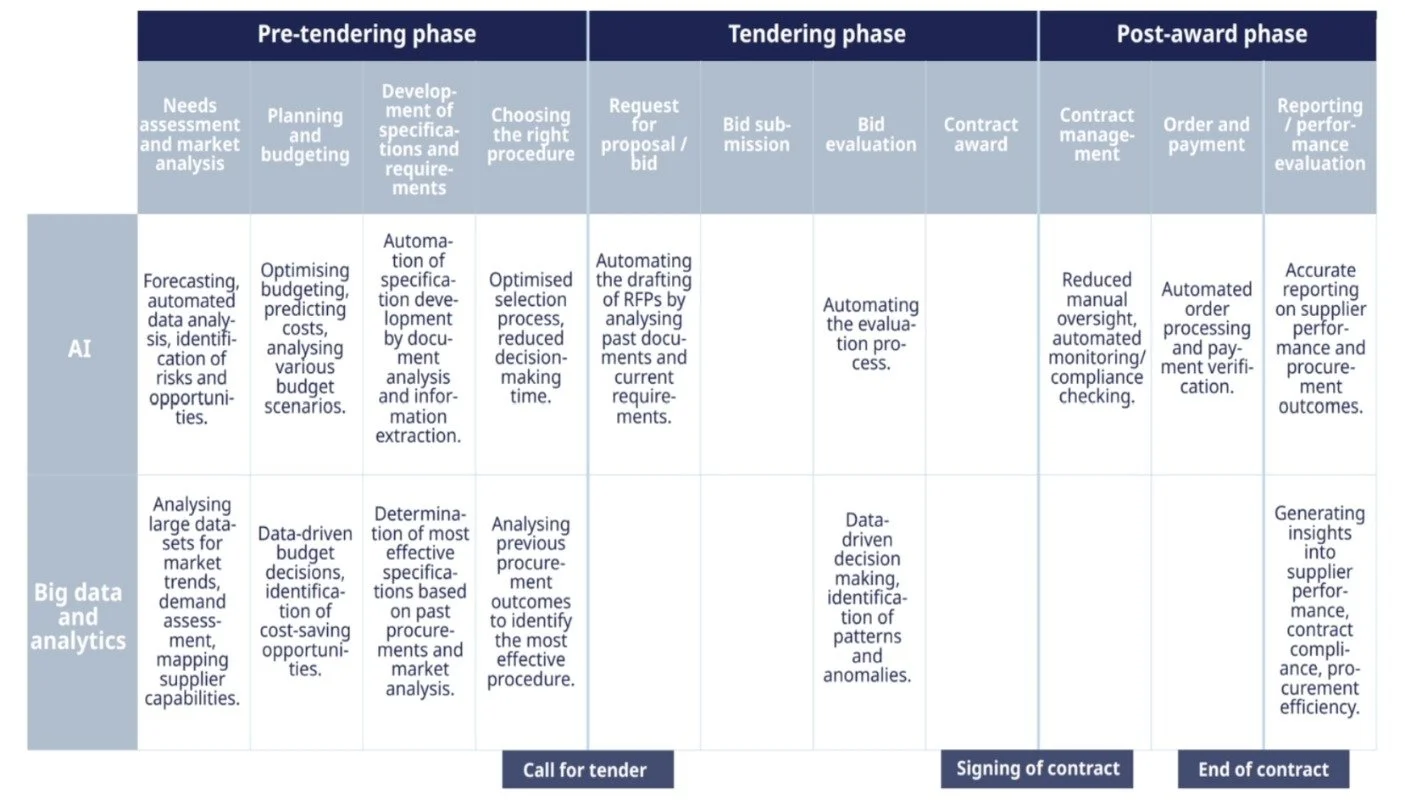
Uses For AI and Big Data/Analytics in a Procurement Cycle
In public procurement, the Organization for Economic Co-operation and Development (OECD) notes that AI can help governments better predict demand, identify potential risks, improve procurement processes, and access performance information in real time. However, while AI can improve procurement efficiency and support better decision-making, human review and oversight are still necessary because. AI tools can sometimes produce inaccurate information or reflect biases in the data it they are trained trains on. Accordingly, , so organizations should review AI-generated results before using them to make important decisions. An organization can begin by checking the AI’s sources to make sure the information retrieved is accurate, compare results with already existing documents or records, and most importantly conduct a peer -review process along with leadership approval.
How AI Helps Procurement and Decision-Making
One of the main ways AI can help with procurement is by reducing the time employees spend reviewing information manually. Procurement departments often manage tens of thousands of transactions, purchase orders, contracts, and vendor records, making it easy for issues to be missed. To address this, some governments have adopted AI-powered procurement systems. In Ukraine, the government worked with expert organizations to develop Prozorro, an open-source public procurement system that helps users track spending, pricing, past and present procurements, and identify potential issues. The system also uses Common Procurement Vocabulary codes and machine learning to better categorize products and services by contract description (OECD, 2025). This reduced some of the manual work for employees while also making it easier for suppliers to find relevant opportunities.
AI can also help identify risks or unusual purchasing activity. The OECD describes another example of a government entity using AI to monitor procurement information and identify possible abnormalities that may deserve additional review. The Comptroller General’s Office in Brazil developed Alice, an AI-powered system that reviews bids, contracts, and public notices across federal agencies. The system flags potential risks and irregularities, helping officials determine whether further review or an audit is needed. In 2023, Alice analyzed nearly 191,000 acquisitions and triggered 203 audits involving contracts worth 27 billion reaisl or the equivalent of about 4.15 billion euros. It has also helped speed up the audit process, reducing the average review time from about 400 days to just 8 days (OECD, 2025).
Collectively, these examples show how AI can support procurement teams by reducing manual work and giving decision-makers better information to guide purchasing.
AI and Supplier Diversity
Generative AI can also support supplier diversity programs. One challenge an agency may face is identifying qualified suppliers outside of the businesses they already use. Supplier information may be spread across vendor lists, certification lists, and legacy purchasing systems, making it harder to find new vendors. AI can help bring this information together and make it easier to search across a larger pool of businesses. The Organisation for Economic Co-operation and Development (OECD) notes that AI can support procurement by matching suppliers to purchasing needs and helping organizations use procurement data more effectively (OECD, 2025). For example, a procurement employee looking for a certified small or minority-owned construction firm could use an AI-supported supplier platform to search vendor profiles, certifications, locations, and industry categories at the same time. This can make qualified businesses easier to find instead of relying mainly on suppliers the organization has worked with recently. The OECD also notes that AI chatbots can help suppliers understand procurement procedures, which may reduce administrative barriers for smaller businesses with less experience in public contracting (OECD, 2025).
Together, these tools can help agencies consider a wider range of suppliers and create more opportunities for diverse businesses to compete. But, while AI can help expand supplier discovery, organizations should also evaluate the data, criteria and algorithms used by these tools to ensure they do not unintentionally reinforce existing procurement patterns or barriers. AI-supported procurement decisions should include human review and managerial oversight, particularly when decisions involve judgement, context, fairness, or potential bias.
Future of AI in Procurement
Although AI can be useful, it can also create risks. One major concern is the quality of the data being used. If supplier information is incomplete or incorrect, AI may produce an incorrect result. There is also the possibility of bias. An AI system that relies heavily on past procurement decisions could repeat patterns that already exist in historical data instead of helping create fairer opportunities. Because of these risks, organizations should not rely completely on automated decisions. NIST's AI Risk Management Framework emphasizes the importance of identifying and managing risks when organizations use AI systems (NIST, 2023). Human review is especially important when decisions involve supplier eligibility, certifications, compliance, contract awards, and the handling of confidential information.
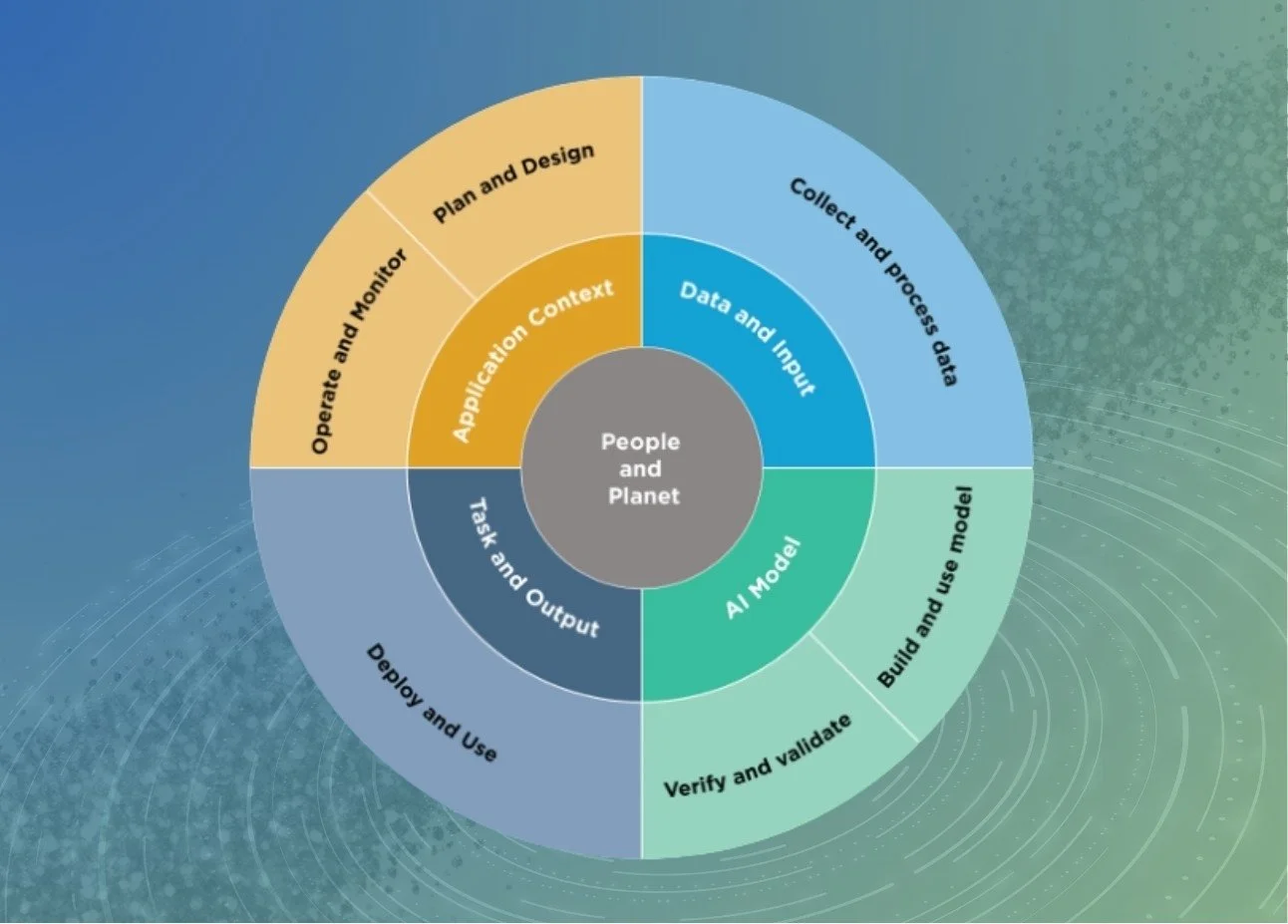
Lifecycle and Key Dimensions of an AI System
How Griffin and Strong PC is Utilizing AI
Currently, the Griffin and Strong data team is utilizing AI as a resource and thinking tool to explore ideas and answer broad coding questions to identify possible approaches to technical issues. Generative AI has made writing code faster by improving already existing code, like automating vendor name, address, and phone number normalization, and in some cases providing a starting point rather than writing everything from scratch. Another useful application for the data team is using AI to automate redundant tasks such as transferring information from publicly available PDFs and documents into Excel spreadsheets. That said, the data team's usage of AI is always balanced with precautionary measures to protect sensitive information. Prompt scenarios are kept generic without revealing project- specific details, and questions are asked broadly rather than providing any confidential context. Most importantly, client data is never uploaded to any AI platform unless it is already publicly available or open- source.
Overall, AI can make procurement work more efficient by helping reduce the overall time spent reviewing, searching, and analyzing by employees, and it can also support diversity by expanding supplier discovery. However, AI should support and not replace human thinking and judgment, especially when decisions require context, fairness, and data that is not open source.
References
Organisation for Economic Co-operation and Development (OECD). (2025)., Governing with Artificial Intelligence: The State of Play and Way Forward in Core Government Functions, OECD Publishing, Paris,
https://doi.org/10.1787/795de142-en.
National Institute of Standards and Technology (NIST). (2023). AI Risk Management Framework. Artificial Intelligence Risk Management Framework (AI RMF 1.0), 1(1).